
CCTV drainage surveys
Drain Survey for Rats
Rats often travel through drains and enter buildings through defects, redundant pipes or broken connections. A drain survey for rats can help identify likely entry routes and records the condition of the pipework so that repairs and pest control can be planned together.
How rats use drains
Rats are strong swimmers and can travel through foul and surface water drains. They follow pipework, often entering from a public sewer or a damaged private drain. A defect such as a displaced joint, a cracked pipe or an open redundant connection gives them a route into the building or the surrounding ground.
In older properties, redundant pipes and disused gullies are common entry points. Rats can also pass through a broken inspection chamber wall or a missing cover. Once inside the drainage system, they may move between properties through shared pipework.
Drains provide shelter, moisture and sometimes food waste. This makes a damaged drain attractive to rodents. A drain survey for rats can help identify likely routes and record the condition of the pipework.
Signs that point to a drain problem
Not every rat sighting means a drain defect. However, some signs suggest that rats are using the drainage system:
- Rats seen near a gully, manhole or external trap
- Droppings in a basement, kitchen or utility area
- Grease or debris disturbed around a chamber
- Persistent pest control activity with rats returning after baiting
- Smell or damp patches near a drain run
- Noise under a floor or around a soil pipe
These signs can also have other causes. A survey helps to confirm whether the drainage is involved and where the likely entry point is.
CCTV surveys for rat entry points
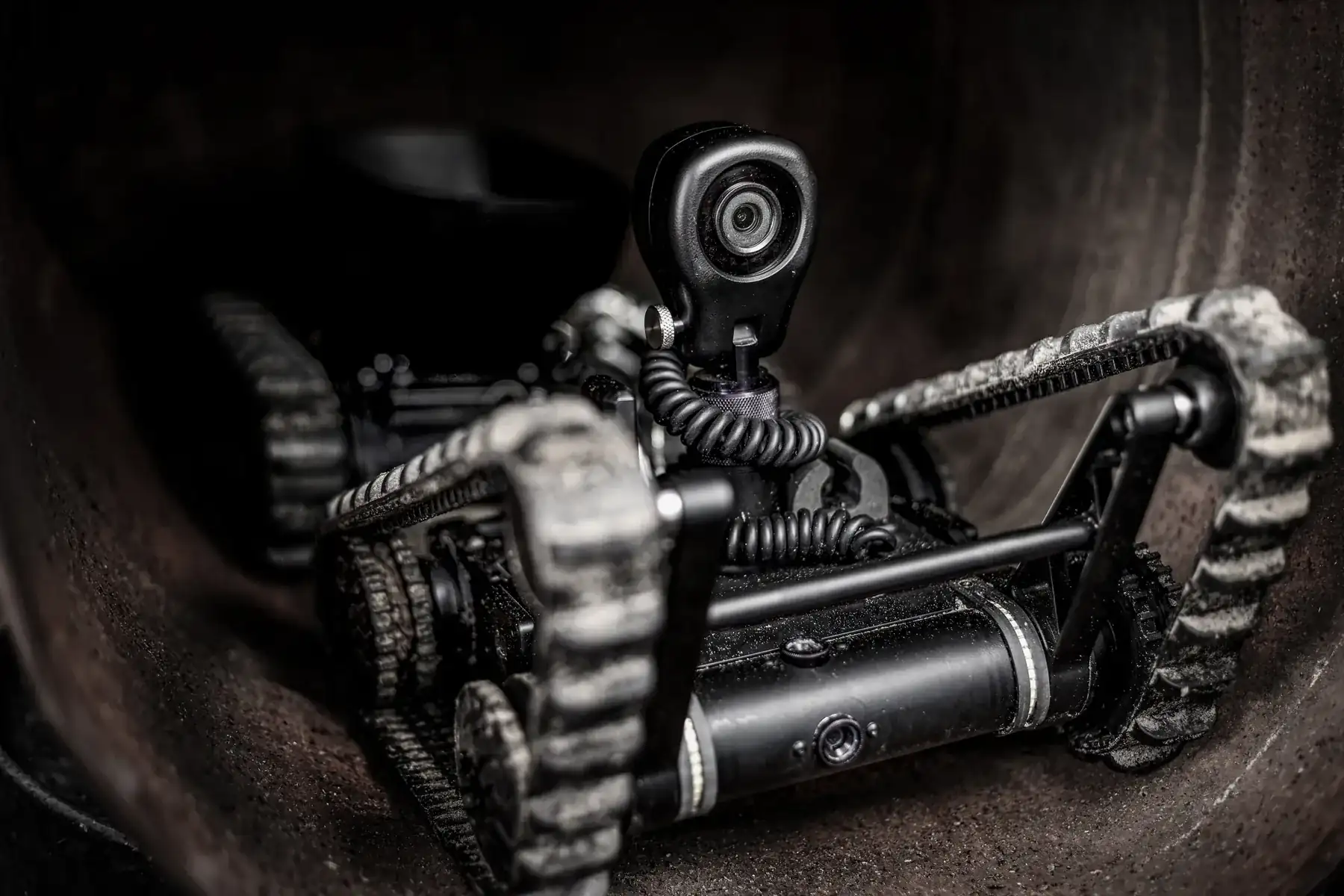
A CCTV drain survey uses a camera on a push rod or crawler to view the internal surfaces of the pipe. The survey can show defects that might allow rats to enter, such as:
- Broken or displaced joints
- Cracks and fractures
- Open redundant connections
- Root ingress that has damaged the pipe
- Collapsed sections or missing pipe walls
- Faulty inspection chamber benching or walls
The camera shows visible internal surfaces. It cannot detect every defect or see through heavy deposits, silt or scale. A survey report describes what was visible at the time and the limitations of the inspection.
Where access is difficult or a pipe is too small for a crawler, a push rod camera may be used. The method depends on the pipe diameter, access and the amount of debris present.
Smoke and dye testing
CCTV shows the inside of the pipe, but it does not always show where a rat can leave the drainage system and enter a building. Smoke testing can help. A non-toxic smoke is introduced into the drain and observed above ground. If smoke appears in a room, a void or a garden, that can indicate a broken connection or a defective pipe.
Dye testing is used to trace flows and confirm connections. A dye is added to a drain or appliance and the colour is watched at another point. This can show whether a redundant pipe is still connected or whether two systems are linked.
Smoke and dye testing can be used alongside CCTV where the question cannot be answered from camera footage alone. Together, the methods can help clarify drainage connections and possible entry routes.
Working with pest controllers
Pest control and drainage work are often needed together. A pest controller can deal with the current rat activity, while a drain survey can help identify likely drainage entry routes. If an entry route is not addressed, rats may return after treatment.
We can help with a drain survey for rats that records the defects and provides a report for the pest controller, landlord or insurer. The report can include photographs, a plan of the drainage and a description of the defects found. It does not replace pest control advice or a repair specification.
Repairs and prevention after a survey
The repair method depends on the defect and the pipe material. Common options include:
- Rat blockers or non-return valves fitted to a suitable pipe or gully
- Patch repairs to a localised defect
- Capping or sealing a redundant pipe
- Localised excavation and replacement of a damaged section
- Relining where the pipe is otherwise sound and the defect is suitable
A rat blocker is a physical barrier that allows flow in one direction and restricts access from the sewer. It is not suitable for every drain. The pipe diameter, flow and position must be checked before fitting.
Patch repairs and capping are often used where the defect is limited. A drain survey before relining is needed if relining is considered, because the pipe must be clean and the defect must be suitable for the lining system.
Repairs to drains on a public sewer or within a build over zone may need water company approval. Requirements differ between England, Wales, Scotland and Northern Ireland. A build over checker can help you prepare questions for the water company, but it does not give permission.
Reports for landlords and insurers
A drain survey report can be used as evidence for a landlord, insurer or loss adjuster. The report should state the survey method, the access points used, the defects found and any limitations. It should not be treated as a guarantee that all defects have been found.
For insurance claims, the insurer may ask for a report that follows a specific format or coding system. Not every survey is graded. The report contents and coding depend on the agreed specification. If a particular format is required, this should be confirmed before the survey is carried out.
We can help with commercial drain surveys for food premises, facilities and landlords where rat activity is a concern. For homeowners, a homebuyer drain survey can be useful before purchase if there are signs of rodent activity or drainage defects.
Access and safety
Drain surveys need access to manholes, inspection chambers and sometimes internal stacks. If a chamber is buried or damaged, access may be limited. We can help with drain survey access requirements so that the survey can be planned.
Work in or near confined spaces, such as deep manholes, is safety-critical. It must be carried out by competent specialists following a safe system of work. We do not provide DIY procedures for confined space entry.
Before any survey, the water company requirements should be confirmed if the drain is adopted or if a build over agreement is in place. This is particularly important where repairs may affect a public sewer.
Free online tool
Build Over Agreement Checker
Check what to ask your sewerage company before building near a drain or sewer.
Common questions
Frequently asked questions
Can a CCTV drain survey find how rats are getting in?
A CCTV survey can show visible defects such as broken joints, cracks, open redundant connections and root damage that may allow rats to enter. It cannot detect every defect or see through heavy deposits. Smoke or dye testing is often used alongside CCTV to trace routes that are not visible on camera.
Will a drain survey stop rats?
No. A survey identifies the likely entry points and records the condition of the drainage. Repairs, rat blockers or other measures are then needed to restrict access. Pest control may also be required to deal with the current infestation.
Do I need a drain survey before fitting a rat blocker?
It is sensible to check the drain first. A rat blocker is not suitable for every pipe. The pipe diameter, flow, position and condition need to be assessed. A survey can show whether a blocker can be fitted and whether other defects need repair.
Can I use a drain survey report for an insurance claim?
A drain survey report can support an insurance claim by recording the defects found. Insurers may ask for a specific format or coding system. The report contents and coding depend on the agreed specification. Not every survey is graded.
Does a drain survey for rats need water company approval?
If the drain is adopted or within a build over zone, water company requirements must be confirmed before a survey or repair is specified. Rules differ between England, Wales, Scotland and Northern Ireland. A build over checker can help you prepare questions, but it does not give permission.
Request a quote
Complete the form and we will get back to you.