
CCTV drainage surveys
Drain Camera Survey
The camera has to suit the pipe. We can help with drain camera surveys using push rod and crawler equipment, pan and tilt heads and sonde location, chosen around the pipe size, the access and what the footage has to prove.
Choosing the right camera for the pipe
A drain camera survey is only as good as the match between the equipment and the pipe it has to travel. The choice is driven by four things: the diameter of the run, the length and shape of it, where the camera can be introduced, and what the footage has to prove afterwards. Get those right and the survey has a better chance of producing usable evidence. Get them wrong and the camera may stop short, or record a picture that nobody can tie to a position.
A drain camera survey may involve push rod or crawler equipment, depending on the access and pipe sizes. The information needed to choose the equipment includes chamber locations, pipe diameters, changes of direction and what the report has to support. Our CCTV drain inspection page covers how a pass is carried out once the equipment is on site.
Push rod cameras
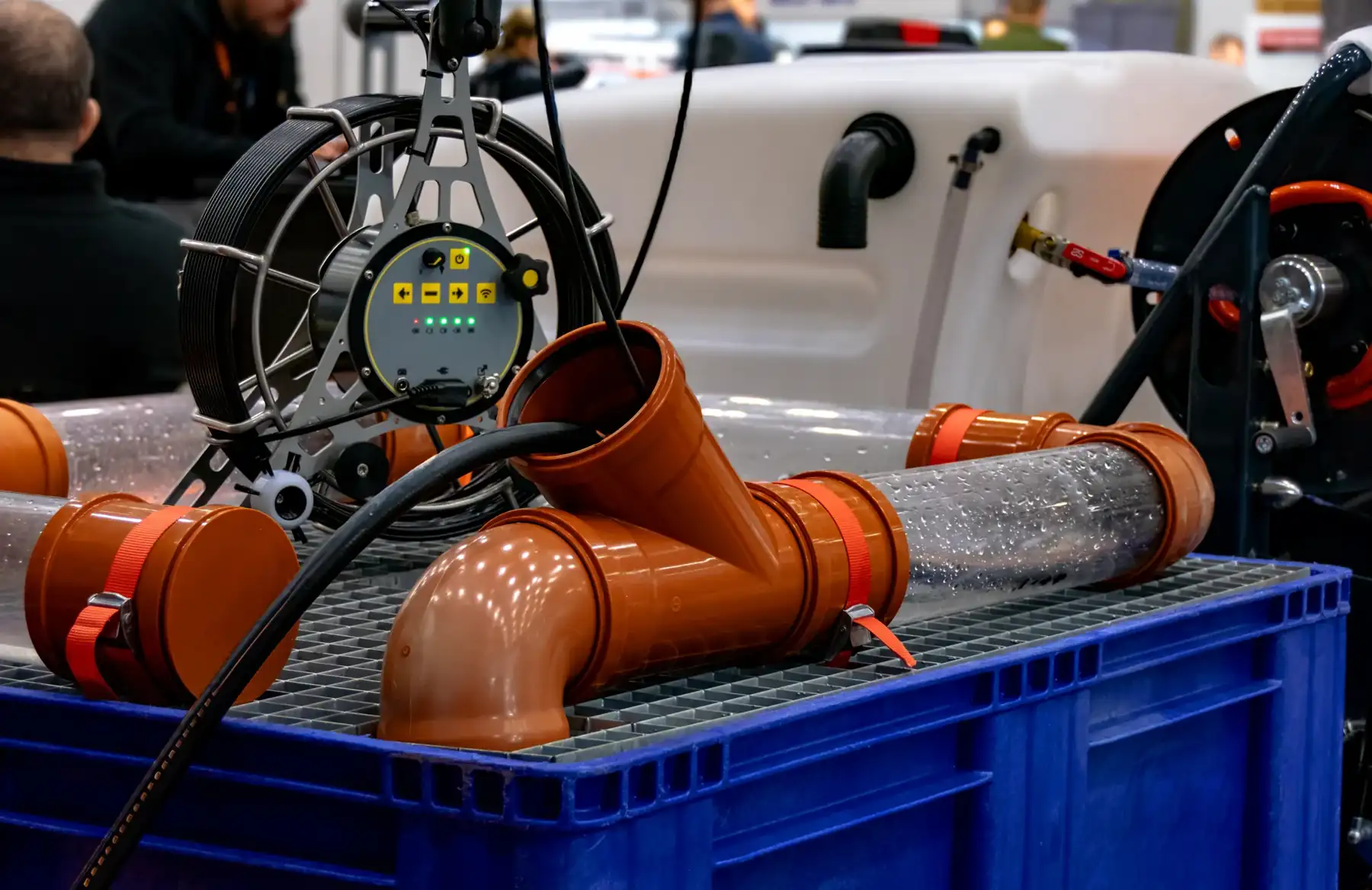
A push rod camera is a camera head on a semi-rigid rod, fed into the pipe by hand from a chamber, rodding eye, gully or open pipe end. It suits smaller diameter drainage and shorter runs, which covers most domestic drains and a great deal of light commercial work.
The limits are reach and friction. A rod loses push as it travels and as it passes bends, so a long run with several changes of direction may stop the camera well before the end. Where the camera stops, what matters is the record: the distance reached, what was visible at that point, and whether the footage shows why the camera could not continue. A collapse, root mass, scale or simply a bend the rod cannot pass may be responsible. A survey should not state a cause the footage does not show.
Crawler cameras
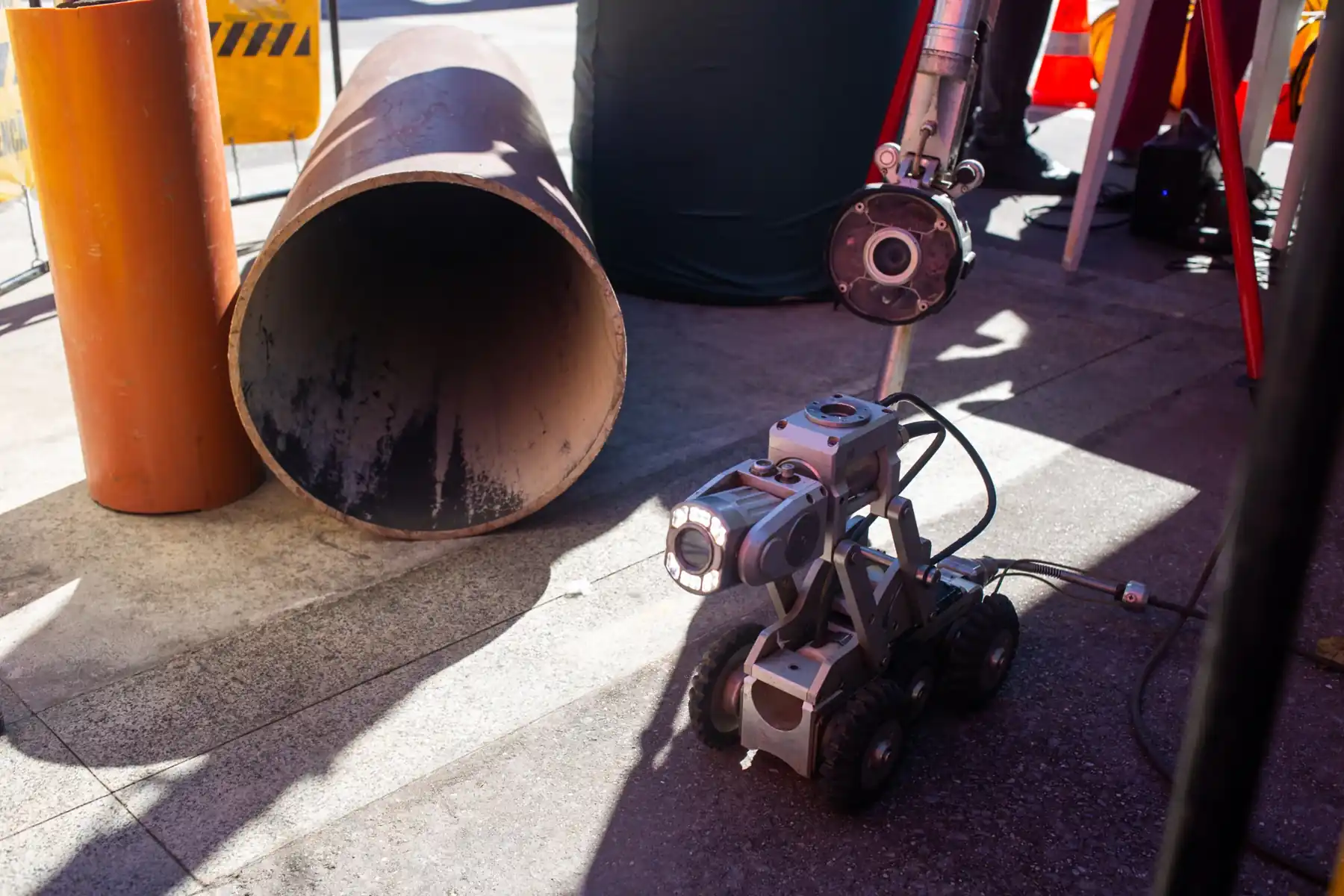
A crawler is a driven, wheeled unit carrying the camera and lighting, often with a pan and tilt head, connected to a control unit by a cable drum. It is commonly used for larger pipes and sewers, where a push rod would not reach and where the diameter allows a machine to drive along the invert.
Crawlers earn their place on long runs. Because the unit drives itself rather than being pushed, it can cover distances that defeat a rod, and the operator can stop, rotate the head and inspect a joint or connection properly instead of passing it at speed. Wheel sizes and modules can be changed to suit the pipe diameter, allowing compatible systems to be configured for different runs on one site.
They also demand more of the site. A crawler needs suitable chamber access for lowering the unit, an invert clear enough to drive along, and a working area for the control unit and cable. A heavily silted sewer may need cleaning before a crawler can pass. High water levels or a surcharged pipe can prevent a conventional crawler survey or require a different approach. For larger systems and sewers, see our sewer CCTV survey and pipeline CCTV inspection pages.
Pan and tilt heads and what the picture shows
A fixed head looks straight ahead. A pan and tilt head rotates and angles, so the operator can examine the pipe wall, the crown and the mouth of a connection rather than relying on a glimpse as the camera passes. On a coded survey that difference matters, because a defect has to be seen well enough to classify, not just noticed.
Two other features decide how useful the footage is later. A distance counter provides a measurement along the run for each observation, although its accuracy depends on the equipment and survey conditions. This helps someone find the same area again. Lighting controls how much of a large pipe is visible at once, since a bright foreground and a dark crown can hide as much as silt does. When comparing survey quotations, these practical features deserve attention alongside the resolution quoted for the camera.
Sondes, locating and depth
A sonde is a small transmitter carried by a compatible camera head or crawler. A locator above ground detects the signal and can provide an estimated position and depth for the transmitter. That is how a defect seen on screen can be related to a position on the ground.
Accuracy depends on depth, the locator, nearby interference and site conditions, so a sonde reading is an approximate working position rather than a survey-grade coordinate. A series of readings along a run is also not the same as a drawn record of the system. Where the layout itself is the deliverable, see drain mapping.
Matching the camera to what the footage has to prove
The same pipe can justify three different surveys, and the difference is the purpose rather than the hardware.
- A look for a known problem. Finding out what is blocking a drain and where. A rod camera with a distance reference may be enough where the pipe and access are suitable.
- A coded condition survey. Observations classified under a recognised system so they can be compared and reviewed. This needs a clear picture at each observation, which may require a pan and tilt head and a cleaned pipe. Our MSCC5 drain survey guide explains the coding.
- A survey for a third party. An adoption, a build over application or an insurer. The recipient may specify the survey method, reporting format and supporting records, so those requirements should be established before choosing the equipment.
Deciding this before the visit helps avoid a second survey because the first one was not recorded in a form the intended reader could use.
Access, cleaning and preparation
Every camera needs a way in. Inspection chambers and manholes are the usual entry points, with rodding eyes and open ends useful for smaller rods. Where a chamber is buried, broken or full, access may need attention before the camera can be introduced. In England, provision for access to below ground drainage is covered by Approved Document H, which is a useful reference for drainage access arrangements, although existing installations may differ from current guidance.
Water and deposits are the other obstacle. A pipe holding standing water hides its invert, and a silted run hides whatever is beneath the silt. Cleaning before the pass can improve what is visible, although it may also remove deposits that would otherwise have been recorded. The report should make clear whether cleaning took place and what could be inspected.
Most camera work is done from outside the chamber. Where entry into a chamber or sewer is necessary and the work falls within the confined spaces requirements, it needs an appropriate safe system of work. The Health and Safety Executive explains the relevant duties in its guidance on confined spaces legislation, including the Confined Spaces Regulations 1997.
What a camera cannot see
A camera records the visible internal surface of a pipe, on the day, under the conditions noted. It cannot see through deposits or standing water, it cannot see the ground around the pipe, and it cannot establish from the picture alone whether a hairline crack is open under load. A pipe that looks poor may still carry flow, and a pipe that looks sound may still leak.
Where the footage leaves a question open, other methods answer different parts of it: dye testing to investigate connections, a second pass after cleaning to examine areas hidden by silt, and a located excavation where the pipe surround is the real question. Our drainage investigation page covers how those methods can be combined.
What affects the cost of a drain camera survey
The main factors are the number and length of runs, pipe diameter, how many chambers need to be opened and how accessible they are, whether cleaning is needed first, whether a crawler and its supporting equipment are required, and the reporting standard requested. A coded report with a plan involves more detailed recording and reporting than footage with notes, even on the same drainage. Our CCTV drain survey cost guide sets out what to ask for in a quotation so that two quotations can be compared properly.
Free online tool
Build Over Agreement Checker
Building over or near public drains and sewers
Common questions
Frequently asked questions
What is the difference between a drain camera survey and a CCTV drain survey?
Nothing substantial. Both describe putting a camera into a drain and recording what it sees. CCTV is the older industry wording and camera survey is how most people describe it. What actually changes between jobs is the equipment chosen, whether observations are coded, and the form the report takes.
When is a crawler camera needed instead of a push rod?
Generally on larger pipes and longer runs, where a rod would run out of push or could not negotiate the distance. A crawler also allows a pan and tilt head to be used, which gives a proper view of joints and connections. It needs chamber access large enough to lower the unit and a reasonably clear invert.
Can a camera survey tell me how deep my drain is?
An estimate, where a sonde is used. The camera carries a transmitter and a locator above ground gives a position and an approximate depth. Accuracy varies with depth, the locator and the ground conditions, so treat the reading as a good working position rather than a measured level.
Does the drain need jetting before the camera goes in?
It depends what is in it. A pipe holding silt or standing water hides its invert, so cleaning first usually produces a far more useful record. Cleaning changes what the camera can see, not the condition of the pipe, and any report should state clearly whether the pass was made before or after.
Will a hired camera do the same job?
A hired camera can show an obstruction or visible damage in an accessible pipe. Some also record footage and distance measurements. The difference is whether the equipment and operator can produce the observations, defect coding and report format needed for the job. If the survey is for an insurer, purchaser or sewerage company, check their requirements first.
How is the footage supplied?
Depending on the survey specification, the results may include recorded video, still images, a written report and a sketch or plan of the runs surveyed. Agree what records and file formats are needed before the work, particularly when the report has to be forwarded to a third party or stored with other site records.
Request a quote
Complete the form and we will get back to you.